
 rld
rld
World Media in English is a peoples' project to bring media in world languages to the global community in English translations and interpretations. Media coverage of issues of vital importance to communities from around the world are translated, with an effort to include interpretation of social, political and cultural context as seen from the perspectives of speakers of the original languages. All reports and analyses are contributed by volunteer global citizens according to guidelines for submissions, and are open to public comment and discussion.
Where change is needed our effort is also on supporting campaigns for outreach and demanding action.
This project is a work in progress and some pages of this website are still under construction, but we already have an important campaign with 90,000 followers like you, and a news article. Please see Campaigns and Currently pages.
Please join our audiences in social media. Please see Contribute page for links to Facebook, Instagram and YouTube. You can also help with creating content and outreach with any amount of your time and experience. Please see Events Page using the link below.
Please share this website on Facebook:
In our world today, appearance of a virus in a city far away can for years take lives and bring anxiety and disruption and grief to millions of us everywhere. Differences of ethnic backgrounds or cultural tendencies, and leaving the solutions to governments can explode to savage violence, displacement and misery that we cannot even watch without horror and shame. The same can also bring hunger to millions continents away adding to many other millions already hungry everywhere. In our world today, profits and employment and enjoyable consumer goods for some can mean loss of living environments and livelihoods for many others, and into future generations.
And these are only some examples easily recognisable at the time we are looking for some. We all know that generally in our world, for much of our human family life can be little more than difficult survival amid deprivation and oppression.
We also know that today our most basic needs and rights: our economies, public health and freedoms are interconnected, and impacted by choices each one of us makes; and that luck of not being among the losers does not absolve us of responsibility to care about each other.
There is no representative world government, but there are billions of us who have come to enjoy relative security and freedom who, thanks to internet and social media and globally spoken languages, now also have the means to learn about each other, and learn about problems and solutions; and ultimately these same billions of us can be more powerful than any other unknowns and adversities.
Learning about each other and problems and solutions on an international level is the purpose of international media, and we have come a long ways in development and availability of these media in only some decades. But comparing reach of these media whether in coverage or in audience engagement with actual challenges ahead does not leave us optimistic.
First hand journalism and worldwide publication and analysis are beyond abilities of most ordinary citizens, but there is a kind of citizen journalism which millions of people can share in building with only knowledge of a native language and English, an internet connection and freedom to use it. And there are billions more who could be audiences of these citizen journalists.
In countries of the world there is variation in development of local and/or native language media, but certainly in these media one can often find more than what reaches the international media, sometimes in reporting of facts and more often in implications of social and cultural context, provided that, especially for international audiences, these implications are interpreted.
This is the purpose of World Media in English: A citizen-sourced online platform where any citizen of the world with an internet connection and working knowledge of English can read or watch reporting and analysis that has been published in languages of the world; and connect the dots too with added "big picture" explanations of context, and have free and democratic conversations about the issues with other audience members worldwide.
Clearly articles made from translations of published media coverage are works of journalism in themselves, and they must be researched based on principles and methods of good public interest journalism. For this purpose we use a set of guidelines that we research and define with the goal to maximize the public education and engagement value. At the same time, these guidelines provide a step-by-step method by which nonexpert citizens can produce professional journalism from their computer desk. With collaboration with universities we are always working to improve on these guidelines.
You can help and make a real difference by just joining our social media and informing yourself, and you can do more by taking part in discussions and creating content.
We encourage sharing, copying and redistribution of any parts of, or entire works of public affairs and history published on this website. We only require an attribution: "By [name of the lead creator] published by World Media in English (wwww.worldmediainenglish.org)". Showing our logo is optional but appreciated. You can download our logo by right clicking on the image below.

The above serves as a legal licence worldwide. Please note this permission only applies to articles and videos of public affairs and history created by our contributors showing their names on our website. It does not apply to material created elsewhere for our websites and social media, and it does not generally authorize adaptations like translations or re-mixings. If you are interested in using our content for public interest purposes we recommend contacting us. We will be happy to provide authorizations for your intended use.
Our online and in-person events provide a safe and democratic space for all citizens of the world to meet and exchange ideas and information. Most of our events are online and we post them here on Events page of the website in advance. Depending on the type of event we may need an email and first name(s) of our participants. Any personal information you share are subject to our privacy policies (Please see Contact page). The language is primarily English, while we we do our best to provide translation where needed.
The following is the list of our current one-time and continuous events:
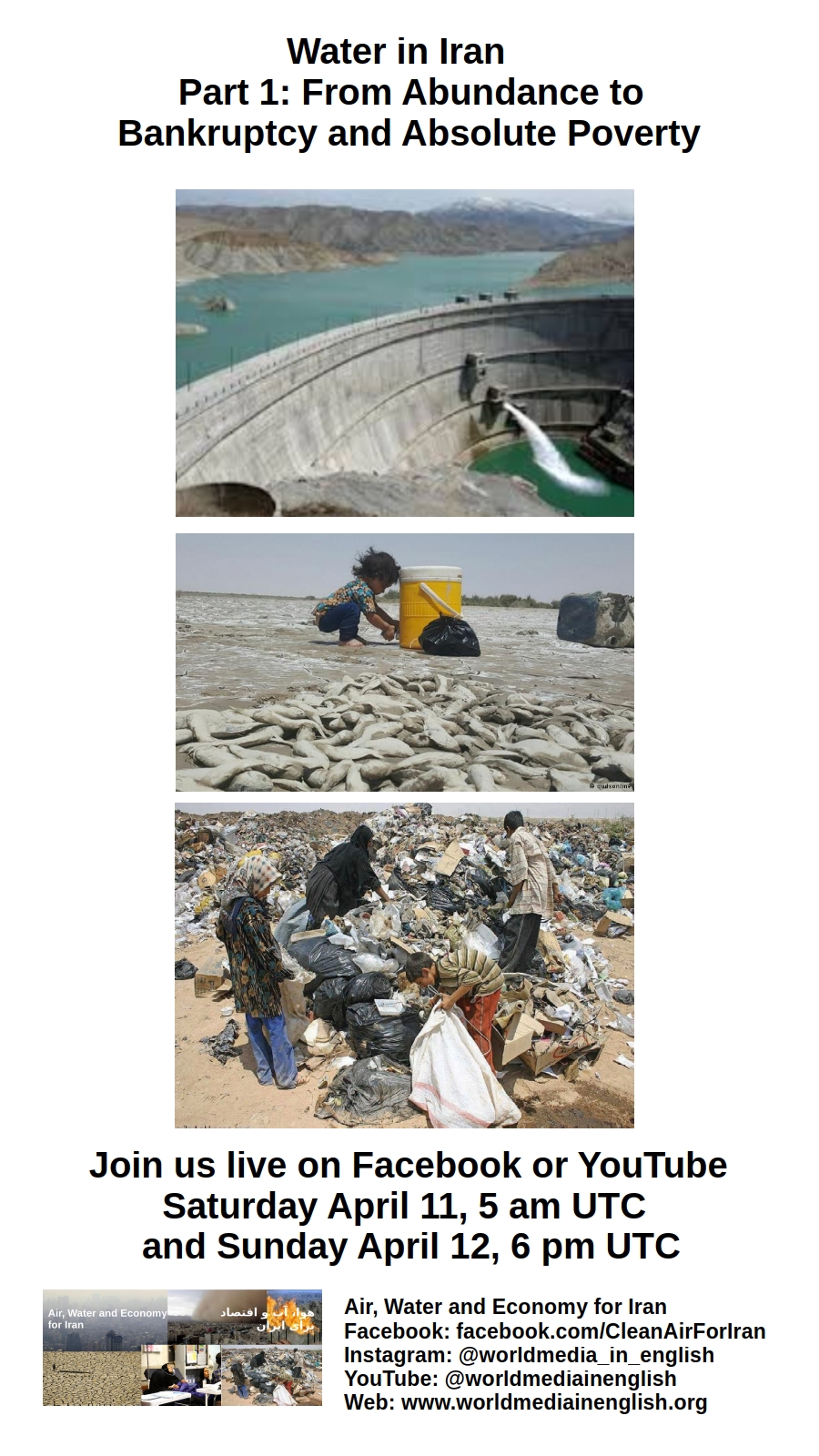 Water in Iran: Part 1: From Abundance to Bankruptcy and Absolute Poverty - Live on Facebook and YouTube (one time, online): This will be a live presentation from "Air, Water and Economy for Iran" campaign on Saturday April 11th, 2026 at 5 am UTC, and repeated on Sunday 12th at 6 pm UTC. The details have been published on the campaign's Facebook Page and the event will be accessible to public. This live presentation and conversations following it will be recorded and posted on our social media as well.
Live Audience on Campus (one time, in person): On Sunday April 12, our campaign's live presentation (as shown above) will be held at 11:00 am PDT from the Student Lounge of Simon Fraser Unversity Public Interest Research Group located at suite 1410 of Student Union Building of this university's Burnaby campus. If you are in Greater Vancouver, Canada this Sunday you can join our live audience in this Lounge. Please send an email with "Live Audience Sunday April 12" in the subject line, and first name(s) of people coming in the email body. Please send this email at least two days in advance (by Friday) and arrive by 10:30 am. There are easy bus routes to the campus and pay parking is easily available on Sundays.
Sundays on Zoom (continuous, online): We love to meet with our audiences worldwide to share our content and work on current projects and suggestions for new plans. Whether you have specialized experience or not, or hours or minutes of your time, or even if all you can do is to help spread the word, you are welcome to join. To accommodate for different time zones the meeting times are flexible with preference for Sundays. To join please send an email indicating "Zoom, Sunday" and the date you wish to attend in the subject line, and include your first name(s) in the email body.
Campus Meetings (continuous, in-person): If you are in Greater Vancouver, Canada please join our campus meetings on Wednesdays from 7 to 8 pm PDT at the Student Lounge of Simon Fraser Unversity Public Interest Research Group located at suite 1410 of Student Union Building of this university's Burnaby campus. Please send an email with "Campus Meeting" and the date you wish in the subject line, and include first name(s) of people coming in the email body. There are easy bus routes to the campus and pay parking is easily available in evenings.
WME in Media (one-time, online): Our volunteers are always happy to be on other media, and of course you can listen or watch on your own. So far we have been grateful to CJSF FM, campus radio station of Simon Fraser University for a number talks: Click on the program titles below to go to the web pages of CJSF where you can listen to the recorded audio files.
February 17, 2023, What is World Media in English? (24 minute talk) July 19, 2023, Morality Police Return and Desertification in Iran (30 minute talk) July 26, 2023, Sudanese Conflict and Iranian Gas Runners (The talk is for 13 minutes starting at minute 8 of the track) August 9, 2023, The real story behind Iran regime’s two-day shut down of the country, and A growing Facebook Page for World Media in English’s work on environments and economies (The talk is for 16 minutes starting at minute 7 of the track) September 28, 2023, Anniversary of a Police Killing and a People's Uprising, and What is Wrong with Iran's Regime (The talk is for 19 minutes starting at minute 8 of the track)
Our email address is: worldmediainenglish.org@gmail.com
World Media in English is a new platform of citizen journalism providing a venue for qualified translators and interpreters to share media in native languages of the world with global audiences in English. This project is built on goals of producing best possible journalism in the public interest, and providing a democratic and nonpartisan space for civic participation and collaboration among people interested in human rights and social justice. Our work is therefore guided by democratic principles of inclusivness and transparency, and not influenced by any special interests. It is approved and supported by Simon Fraser University Public Interest Research Group (SFPIRG).
To maximize the value of our publications and discussions we use a set of guidelines that are defined based on principles and methods of good public interest journalism. Within these guidelines our contributors are free to choose their subject matter and express views and opinions, and they remain the only authors and editors of their work. We encourage feedback from our audiences and hold ourselves accountable to all legitimate criticism.
Our work is not possible without help of our volunteers. No experience is necessary and there is no minimum time commitment required to join our online organising meetings. Please see Events for details. On our Events page you can also hear or watch presentations on other media by our volunteers who talk about our current projects and how you can help.
Currently founder Ramtin Bashi is our lead volunteer.
 Ramtin Bashi: Since young age Ramtin was interested in people and what was important to their well being, and this led to his interest in public affairs and the role of media in shaping public participation and policy. He came to adulthood in his native Iran when the post-revolutionary regime had reached the dimensions of a dictatorship. He fled the country and reached Canada as a refugee. In Canada he earned a bachelor degree in engineering and has worked in a number of industries. In a country with higher civil liberties, more so than before he continued to follow and study media with an inquisitive mind. In 2013 and 14 he put together the main elements of World Media in English, a working draft of guidelines and a first news article. In 2015 he initiated the "Air, Water and Economy for Iran" campaign which he helps develop from this platform as well.
Please watch our Questions and Answers video on YouTube:
You can also open and download a PDF transcript of this conversation from this link: World Media in English Q&A (PDF)
Our poster contains a more general description: World Media in English Poster (PDF)
Mailing List: We announce our one-time events and new publications on our mailing list. Our announcements are generally not expected to exceed once a month. To join our mailing list, please send us an email with "Mailing List" in the subject line, and your first names(s) or organisation's title in the email body.
Questions and Contributions: We welcome your questions, ideas and suggestions about content and outreach, while unfortunately we are unable to respond to individual email messages. Whether or not you have specialised experience, and whether you have minutes or hours of your time to give, you are welcome to attend our online or in-person meetings. We only need an email with your first name(s) to send you an invitation. Please see Events Page of our website for more details.
We do not send additional email messages, and we do not ask for money donations.
Our email address is : worldmediainenglish.org@gmail.com
Privacy Policy: We keep your contact information, and any other personal information you may share with us srtictly confidential and secure, and we will use them only for your intended purpose. You can unsubscribe and have your information deleted from our servers any time by sending us an email with "Unsubscribe" in the subject line.